Project Generator

What is a Project Generator?
A project generator is an exploration company whose core business extends beyond the discovery of mineral deposits. Its role is to identify promising ground, add sufficient early-stage value to make it attractive, and then secure well-funded partners willing to assume the cost and risk of the next phase of exploration in exchange for an earned interest in the property. Rather than funding every drill program independently, a project generator allocates its exploration capital across acquiring and modestly advancing a broad range of properties, allowing outside capital to carry the greater share of cost on those that demonstrate the most promise.
Eagle Plains has operated this way for decades, long before the "project generator" model became commonplace in the industry.
Project Generation
-
Before the term "project generator" came into common use, Eagle Plains had already concluded that allowing partners to fund exploration on its ground, in exchange for an earned interest, was the more sustainable way to build a portfolio. This approach keeps EPL's exposure to the financial risk of exploration low while preserving its exposure to the upside of discovery. In essence, that is the model.
Image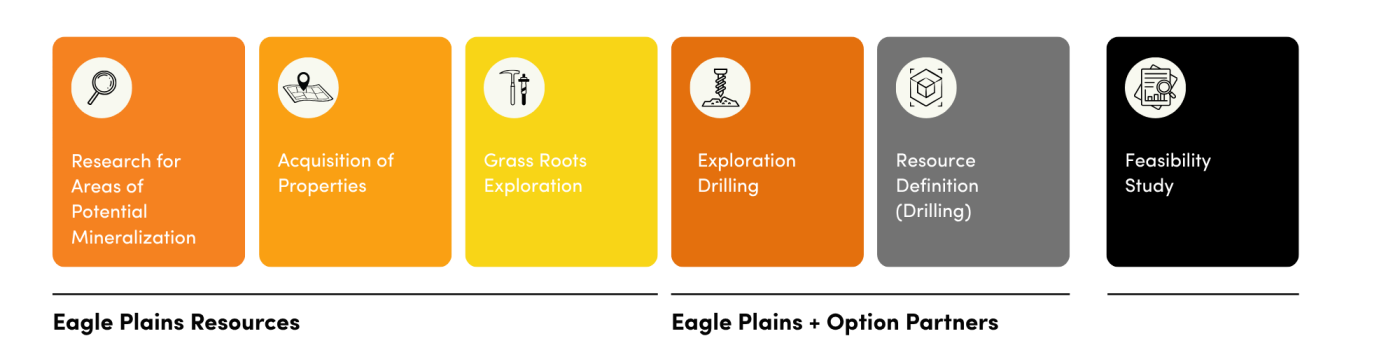
Project Deal Flow
Frequently Asked Questions
What is a project generator, in simple terms?
A project generator acquires and lightly advances mineral properties, then brings in partners who fund the more expensive stages of exploration in exchange for an earned ownership interest. It's a way of staying exposed to many discovery opportunities without having to pay for all the drilling.
How does the project generator model reduce risk for investors?
Because partner companies fund the bulk of the exploration spending on optioned projects, a weak result on any single property doesn't drain the generator's treasury. Shareholders keep exposure to the upside of a discovery across many properties, without the company having carried the full cost of testing each one.
How do project generation companies actually make money for shareholders?
Primarily through the cash and share payments received under option agreements, the retained ownership interest and royalty (typically an NSR) that stays with the generator after a deal completes, and, over the longer term, the potential for a discovery on a partner-funded project to significantly increase the value of the generator's retained stake.
Eagle Plains is unique among project generators as is wholly owned subsidiary, TerraLogic Exploration, generates significant revenue for the company. This greatly reduces the dependency on capital raises to finance exploration work.
What should investors look for in a mineral project generator?
A large, geographically and commodity-diversified project portfolio; a track record of actually completing option deals (not just holding ground); a tight share structure and healthy treasury; and retained royalties or interests that preserve long-term upside even after a project is optioned out.
Which project generators focus on critical minerals, uranium, or rare earth targets?
Eagle Plains' current portfolio includes uranium-focused option deals in Saskatchewan's Athabasca Basin region and a critical-minerals option deal in British Columbia, alongside gold, copper, and rare earth element projects elsewhere in the portfolio.
What causes junior explorers to underuse project generation partnerships?
Often it comes down to a reluctance to give up 40–60% of a project's upside in exchange for funding, or difficulty finding a partner whose risk tolerance and timeline genuinely align. Companies that avoid partnerships tend to concentrate their exploration risk on fewer, self-funded properties instead.