
Corporate Incubation
Corporate Incubation & Spin-outs
In the context of mineral exploration, corporate incubation refers to the practice of developing a promising project, business line, or asset within the shelter of an established parent company until it has matured enough to stand on its own as a separately listed public entity. Rather than simply selling a mature asset outright, the parent structures it, often together with a dedicated management team, technical data, and some working capital, into a new public company, then distributes ownership of that company directly to its own shareholders. This is typically referred to as a spin-out.
Eagle Plains has used this approach repeatedly over more than two decades, and it forms one of the more distinctive parts of the company's business model.
What This Has Meant for Shareholders
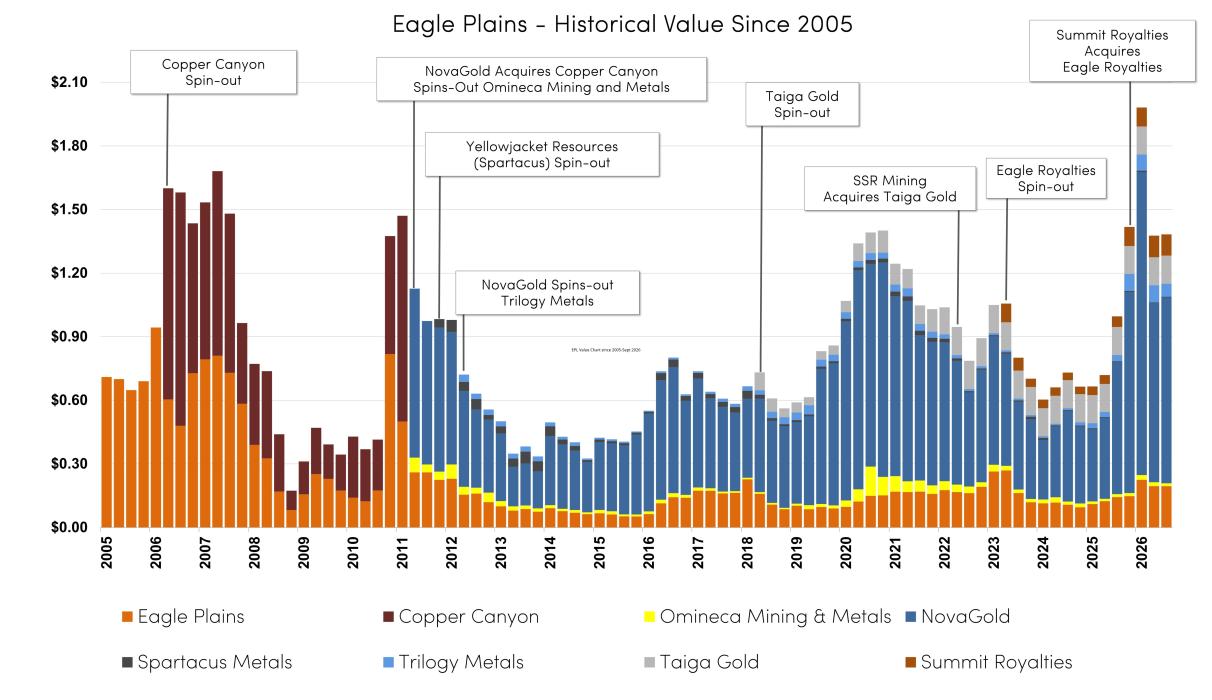
The Eagle Plains model of spinning out mature assets rather than simply holding or selling them outright has become a consistent way to convert in-house discoveries into direct, liquid value for shareholders. It is also worth noting what these spin-outs are not: a share distribution to existing holders is not a financing, and it does not dilute existing shareholders the way issuing new stock for cash would. Two separate transactions the history (Copper Canyon's acquisition by NovaGold in 2011, and Taiga Gold's acquisition by SSR Mining in 2022) confirm that the model can carry all the way through to a full corporate acquisition by a larger mining company, not just a listing.
This approach has also resulted in unusually modest share growth for a company of EPL's age. Between December 2019 and December 2025, Eagle Plains' total shares outstanding grew by roughly 23%, a notably low rate of dilution compared with a number of other Canadian-listed companies that employ a similar project generator model over the same period. For more information about individual spin-out transactions, please see the Spin-Out Details section below.
A History of Value Creation

The Challenge
A diversified junior explorer with dozens of properties faces a structural problem: a single standout asset, even a genuinely significant one, tends to get lost among everything else the company holds. Investors and analysts pricing the stock generally value it on the whole portfolio, or on cash and near-term catalysts, rather than crediting full value to one promising property buried among many. The result is that a company's best asset can sit meaningfully undervalued for years, simply because it is one line item in a much larger, more complicated story.
The Solution
Spinning out the asset into its own separately listed company addresses both problems at once. It crystallizes value the market was not yet recognizing inside the parent, by giving that asset its own share price, its own investor base, and its own news flow. It also creates a cleaner acquisition target: a small, focused public company with a defined asset is generally easier for a larger mining company to evaluate and acquire than a single property tucked inside a much larger, unrelated portfolio. Shareholders of the parent company receive shares in the new entity directly, at no additional cost, and retain the option to hold, sell, or add to that position independently of their original holding.
Spin-out Details
2006: The First Spin-Out, Copper Canyon Resources
On a one-for-one distribution, Eagle Plains shareholders received one share of newly listed Copper Canyon Resources (TSX-V: CPY) for every EPL share held, with Copper Canyon beginning to trade at close to C$1.00 per share. This was the first practical demonstration of the model: an asset the market was not yet crediting to EPL's own share price was carved out into its own separately listed vehicle and delivered directly to shareholders, at no cost to them.
2011: NovaGold Acquires Copper Canyon and OMM Is Formed
In May 2011, NovaGold Resources acquired Copper Canyon in a share exchange, and Copper Canyon shareholders simultaneously received shares in a newly formed Omineca Mining and Metals for every Copper Canyon share they held. Later that same year, in December 2011, Eagle Plains distributed shares of Yellowjacket Resources directly to its own shareholders. Yellowjacket was renamed twice over the following years, first to Athabasca Nuclear Corp. and later to Dixie Gold Inc., which completed a share consolidation in January 2020.
2012: NovaGold Spins Out NovaCopper, Later Trilogy Metals
In April 2012, NovaGold distributed shares of a new subsidiary, NovaCopper Inc., to its own shareholders. NovaCopper was later renamed Trilogy Metals Inc. (NYSE American / TSX: TMQ). Because NovaGold's 2011 acquisition of Copper Canyon had already passed through to EPL shareholders as NovaGold shares, this distribution extended the same value chain a further generation beyond the original 2006 Copper Canyon spin-out.
2018: Taiga Gold Corp.
Eagle Plains distributed shares of Taiga Gold Corp. (CSE: TGC) to its shareholders in April 2018, on a basis of one Taiga share for every two EPL shares held. Taiga's principal asset, the Fisher Gold Project in Saskatchewan's Trans Hudson Corridor, attracted the attention of SSR Mining, which first formed a joint venture on the property in January 2021 before agreeing, in December 2021, to acquire Taiga outright for C$0.265 per share in cash, a transaction that closed in April 2022.
2023 to 2025: Eagle Royalties
In May 2023, Eagle Plains spun out Eagle Royalties, a holding company formed to consolidate more than 35 net smelter return royalties the company had accumulated through years of option agreements. This spin-out differed from the earlier ones in an important way: rather than being built around a single project, it gave shareholders exposure to a diversified portfolio of royalty interests spread across many properties. In November 2025, Eagle Royalties was restructured into Summit Royalties Ltd. (TSX-V: SUM) through a reverse takeover and share consolidation, giving former Eagle Royalties shareholders an ownership stake in a larger, multi-asset royalty company.
Elements of the Business Model


Latest News Releases


Eagle Plains Partner Sun Summit Completes 2026 Program at the Theory Project, Toodoggone District, BC


Eagle Plains Reports Additional Results from Drilling at the Don Lake Uranium Project, Saskatchewan

Eagle Plains and Earthwise Intersect Gold Mineralization in all Holes at the Iron Range Precious Metals Project, SE BC

