
Haskins Project
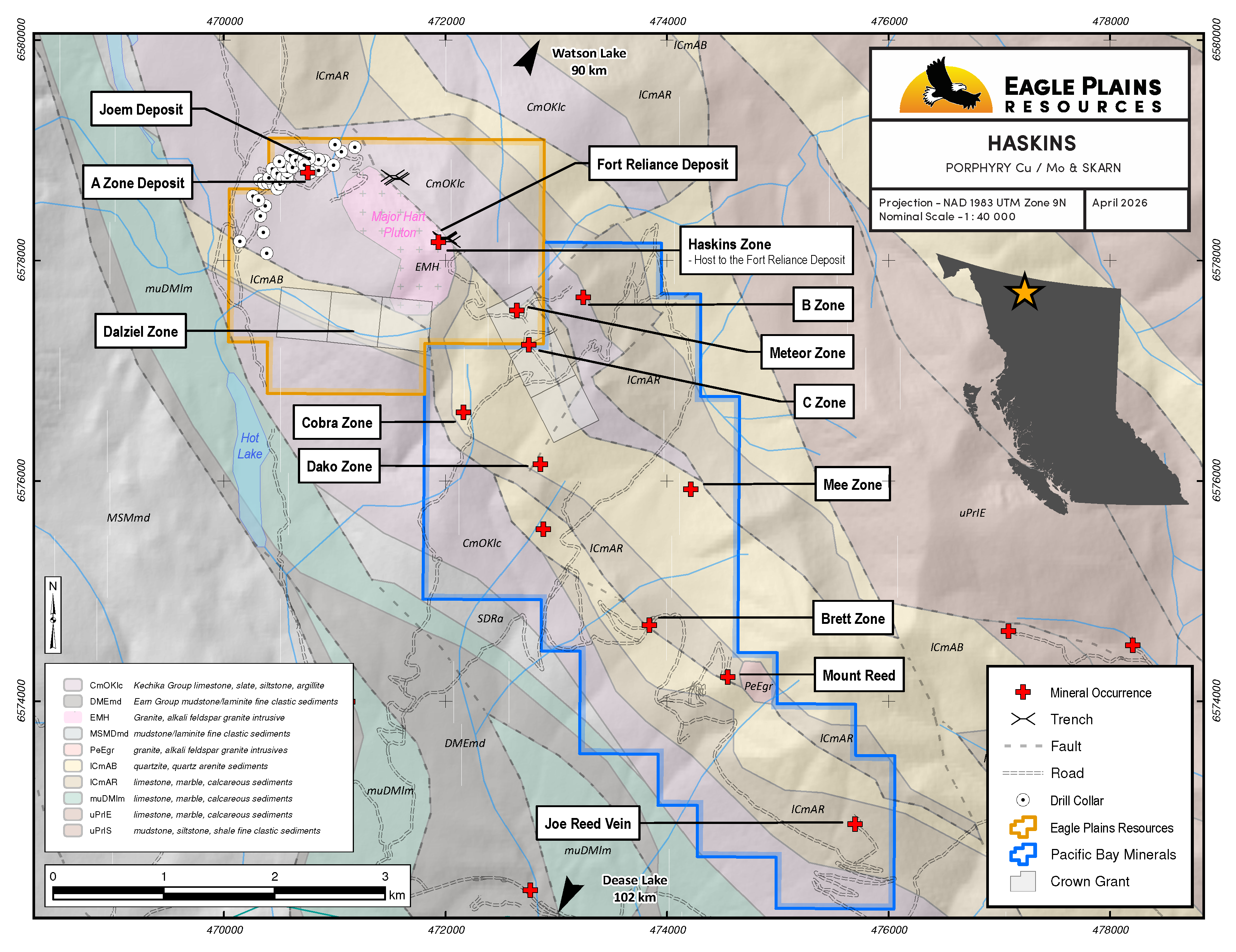
The 578 ha road accessible Haskins project is located 105km NE of Dease Lake, BC. The Haskins is considered to be highly prospective for carbonate replacement, multi element skarn type, molybdenum-tungsten stock work porphyry and structurally controlled silver-lead-zinc vein mineralization.
The claims are 100% owned by Eagle Plains with a 2% NSR held by Summit Royalties containing a 1% buy-back clause.
-
- British Columbia
-
- Available for option: No
-
- Silver,
- Copper,
- Lead,
- Molybdenum,
- Zinc
Project Highlights
- Host to the Fort Reliance and Joem deposits
- Excellent geology highly prospective for carbonate replacement, skarn, porphyry, and vein mineralization
- Road accessible
- Contact metamorphism of the Kechika siltstones and the Atan Group limestone and quartzites by the intrusion of the granitic Major Hart Pluton caused skarn alteration, as well as the presence of Mo-W stockwork mineralization at lithological contacts and Ag-Pb-Zn bearing veins controlled by cross-cutting fault structures
Summary
The 578 ha road accessible Haskins project is located 105km NE of Dease Lake, BC. The Haskins is considered to be highly prospective for carbonate replacement, multi element skarn type, molybdenum-tungsten stock work porphyry and structurally controlled silver-lead-zinc vein mineralization.
The claims are 100% owned by Eagle Plains with a 2% NSR held by Summit Royalties containing a 1% buy-back clause.
Project Highlights
- Host to the Fort Reliance and Joem deposits
- Excellent geology highly prospective for carbonate replacement, skarn, porphyry, and vein mineralization
- Road accessible
- Contact metamorphism of the Kechika siltstones and the Atan Group limestone and quartzites by the intrusion of the granitic Major Hart Pluton caused skarn alteration, as well as the presence of Mo-W stockwork mineralization at lithological contacts and Ag-Pb-Zn bearing veins controlled by cross-cutting fault structures
Option Agreement - Pacific Bay Minerals Ltd.
Eagle Plains Resources entered into an option agreement with Pacific Bay Minerals TSX-V:PBM) (“Pacific Bay” or “PBM”) on July 7, 2026, pursuant to which Pacific Bay has been granted the exclusive right to acquire up to a 100% interest in the Eagle Plains’ wholly-owned Haskins critical metals project (“the Project”).
Under the terms of the Agreement, Pacific Bay may acquire a 100% interest in the Haskins Project by completing the following over a four-year period:
- Within 14 days of receipt by PBM of the approval of TSX Venture Exchange to the terms of the Agreement, pay EPL 200,000 common shares of PBM.
- On or before the 1st Year anniversary of the Agreement, pay EPL an additional 300,000 common shares of PBM.
- On or before the 2nd anniversary of the Agreement:
- Pay EPL an additional 750,000 common shares of PBM
- PBM to have completed at least $150,000 in exploration work on the Property, with expenditures during the first year of the Agreement capped at $50,000
- On or before the 3rd anniversary of the Agreement:
- Pay EPL an additional 1,000,000 common shares of PBM
- PBM to have completed an additional $250,000 in exploration work on the Property
- On or before the 4th anniversary of the Agreement:
- Pay EPL an additional 2,000,000 common shares of PBM
- PBM to have completed an additional $500,000 in work on the Property
Geology
The Mount Haskins property lies within the northern extension of the Omineca lithotectonic domain, underlain by the sedimentary Cassiar Platform of the Cariboo/Cassiar terrane, which has been intruded by Eocene granitic stocks. Regional structural trends of folding and faulting are dominantly NW.
Mineralization
There are four deposit types in the Mount Haskins area: carbonate replacement, skarn, porphyry, and vein.
Eagle Plains - A Project Generator
Eagle Plains Resources is a project generator with several mineral exploration properties of merit that meet qualifying transaction requirements. We facilitate the listing process for capital pool companies and initial public offerings while providing technical expertise for exploration programs. Companies interested in co-operatively exploring any of our projects please contact: Chuck Downie at ccd@eagleplains.com or Andrew Wilson at abw@eagleplains.com or call 1 866 Hunt Ore (486 8673).
Details
Geology
The Mount Haskins property lies within the northern extension of the Omineca lithotectonic domain, underlain by the sedimentary Cassiar Platform of the Cariboo/Cassiar terrane, which has been intruded by Eocene granitic stocks. The platform is made up of the Cambrian-Ordivician Kechika Group and Lower Cambrian Atan Group of clastic sediments. Regional structural trends of folding and faulting are dominantly northwesterly, with local secondary northeast-trending faulting.
The peak of Mount Haskins is dominated by the alkali feldspar granitic Major Hart Pluton. The granite stock has a coarse-grained porphyritic core which grades to fine, locally silicified granitic marginal phases with an aplitic chill margin. The pluton intruded into a sedimentary suite of rocks comprised of the Kechika Group siltstones, and the Boya Formation quartzites and Rosella Formation limestones of the Atan Group. The argillaceous rocks of the Kechika Group have been pervasively metamorphosed to hornfels nearing the porphyry.
The package of Atan Group sediments is composed of interbedded quartzite with phyllite and limestone with dolostone, northwest to northerly striking, moderate to steeply southwest dipping. The Lower Cambrian Rosella Formation consists of thin to thick bedded limestone, partially replaced by coarse, orange-weathered secondary dolomite, with recessive slatey to muddy interbeds. The limestone, commonly folded, may be recrystallized or altered to skarn or chert due to the presence of the nearby porphyry. The Rosella limestone rests conformably above the Boya Formation, which occurs as rubbly subcrop. The Boya Formation is a siliciclastic sequence consisting predominantly of quartzite with interbedded slate and siltstone, likely representing a shallow marine fan-top facies.
Pyrrhotite and sphalerite are the most abundant sulphides reported on the property, while galena, pyrite, arsenopyrite, and chalcopyrite may also be present. The patterns of mineralization and alteration are related to the emplacement of the granitoid magma, creating complex adjacent hydrothermal systems. Four types of mineralization associated with the granitic intrusion have been described:
- metasomatized metapelitic hornfels hosting stockwork molybdenum-tungsten mineralization
- series of northwest and northeast trending faults which control sulphides-skarn development and Ag-Pb-Zn bearing veins
- quartz-molybdenite stockworks within the granitic pluton, concentrated along the peripheral edge
- massive sulphide lenses and replacement beds associated with skarn alteration within sedimentary units and at their contacts
The granitic intrusion has a chilled peripheral shell of mixed carbonate skarn with elevated molybdenum and tungsten, alongside minor porphyry style mineralization within the intrusive rocks. Dykes originating from the principal intrusion were present close to the Fort Reliance mineral zone and it is likely that similar dykes will be found elsewhere in proximity to skarn-type metallic mineralization.
Polymetallic carbonate-replacement deposits and associated skarn mineralization form by the reaction of high temperature hydrothermal fluids (>>250° C) generated in igneous (i.e. porphyry) environments with carbonate bearing country rocks. The deposits form when magmatic-hydrothermal fluids expelled from cooling magmas react chemically with carbonate-rich sedimentary rocks.
History
The Haskins-Reed Property has been explored in several phases by different companies since the late 1940s, including approximately 198 drill holes. The 100% owned land package, which includes 6 “Crown Grant” claims, is host to multiple mineral prospects.
- B Zone (Minfile 104P 038): Skarn-hosted semi-massive to massive sulphide lenses, with silver- and gold-bearing pyrrhotite-sphalerite-chalcopyrite-galena mineralization, are hosted by metasomatized carbonate rocks. Mineralization occurs as three lenses with an aggregate strike length of 308 metres, an average true width of 8 metres, and an average dip of -40° with strong vertical continuity.
- Mount Reed molybdenum-tungsten prospect (Minfile 104P 043): Molybdenum and tungsten mineralization is hosted by peripheral contact metamorphic exoskarn developed in carbonate-rich metasedimentary rocks of the Atan Group. These rocks surround a small Eocene-age porphyritic granitic stock, with additional porphyry-style mineralization found within the intrusion itself. Historical drilling returned values of 2.01% WO3 over 3.3 metres, 0.37% WO3 over 5.18 metres and 0.17% WO3 over 54.8 metres.
- Joe Reed vein prospect (Minfile 104P 021): Silver-rich sphalerite-galena-pyrite shear-hosted vein mineralization occurs within a persistent northerly-trending fault zone that cuts through Lower Cambrian Atan Group quartzite, limestone, and dolomite. A steep, westerly-dipping quartz vein averaging 1.5 metres wide can be traced along strike for 170 metres.
- Brett Zone (Minfile 104P 136): Skarn-hosted massive sulphide zone with silver- and gold-bearing pyrrhotite-sphalerite-chalcopyrite-galena mineralization is hosted by metasomatized metasedimentary rocks immediately northwest of the Mount Reed stock.
- Dako and Cobra zones (Minfile 104P 139, 058): Disseminated to locally massive pyrrhotite-rich base metal garnet skarn mineralization is hosted at a limestone-argillite contact within metasedimentary rocks altered to calc-silicate hornfels and skarns. Mineralization consists of pyrrhotite, sphalerite, and minor galena and chalcopyrite. The local geology is very similar to the Brett Zone.
- Meteor Zone (Minfile 104P 137): This polymetallic gold-silver-lead-zinc skarn-hosted prospect was discovered during the 2010 trenching program while evaluating coincident soil geochemical and aeromagnetic anomalies in the northcentral portion of the Property. It has been traced over 555 metres of strike length, with widths ranging from 4 to 16 metres, and remains open along strike and down-dip. 2010 excavator trenching returned intervals such as 24.70 metres grading 0.292 g/t Au, 57.11 g/t Ag, 1.21% Pb, and 3.67% Zn (Trench #4), with a nearby grab sample returning 0.680 g/t Au, 176 g/t Ag, 0.75% Pb, and 12.30% Zn. 2011 drilling intersected 17.5 metres grading 88.35 g/t Ag, 1.11% Pb, and 3.39% Zn.
Some of the above results were taken directly from MINFILE descriptions and assessment reports (ARIS) filed with the BC government. Management cautions that historical results were collected and reported by past operators and have not been verified nor confirmed by a Qualified Person but form a basis for ongoing work on the subject properties.
Eagle Plains - A Project Generator
Eagle Plains Resources is a project generator with several mineral exploration properties of merit that meet qualifying transaction requirements. We facilitate the listing process for capital pool companies and initial public offerings while providing technical expertise for exploration programs. Companies interested in co-operatively exploring any of our projects please contact: Chuck Downie at ccd@eagleplains.com or Andrew Wilson at abw@eagleplains.com or call 1 866 Hunt Ore (486 8673).
Updated July 14, 2026
