
George Lake Project
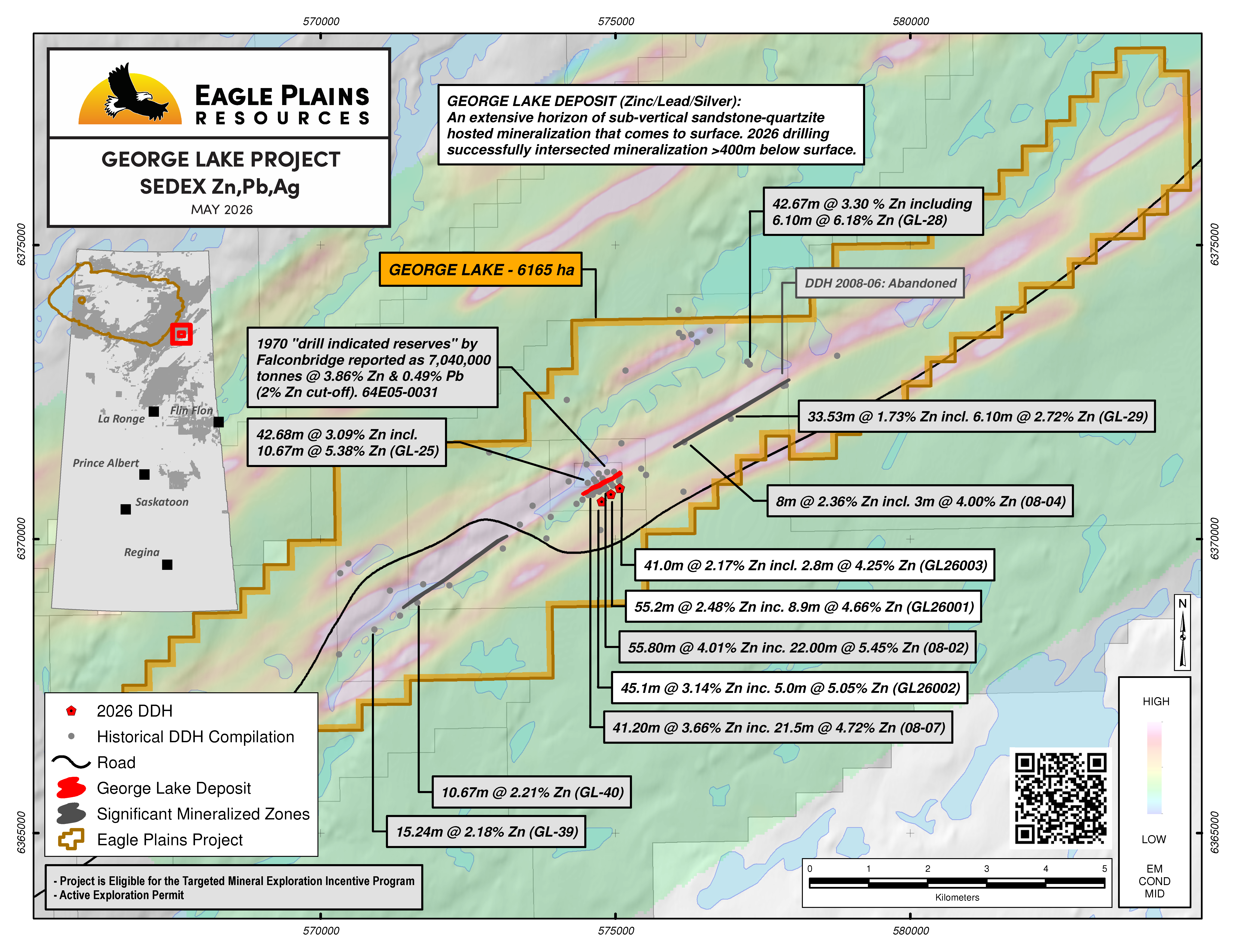
The 6165 ha George Lake Property is host to the historical, sediment-hosted, George Lake Deposit. The mineralized horizon is stratigraphically controlled, sub-vertical, and mineralization is zinc and lead dominant. Step-out drilling by Eagle Plains in 2026 has defined mineralization to a vertical depth of >400m from surface. Mineralization remains open along strike and to depth.
The property is located 280 km northeast of La Ronge, Saskatchewan and is accessible by a newly constructed, all-season road.
-
- Saskatchewan
-
- Available for option: Yes
-
- Lead,
- Silver,
- Zinc
Project Highlights
- Host to the historically defined George Lake Deposit (SMDI 0663);
- Deposit is a predictably mineralized sandstone horizon dominated by zinc and lead with accessory silver, gallium and germanium;
- Historical drilling includes 57.9m grading 2.65% Zn and 0.41% Pb (including 13.5m grading 4.36% Zn and 0.76% Pb) (DDH GL08-01) and 47.8m grading 4.03% Zn and 0.44% Pb (including 8.0m grading 6.96% Zn and 1.42% Pb) (DDH GL08-02) (SMAF 64E05-0033);
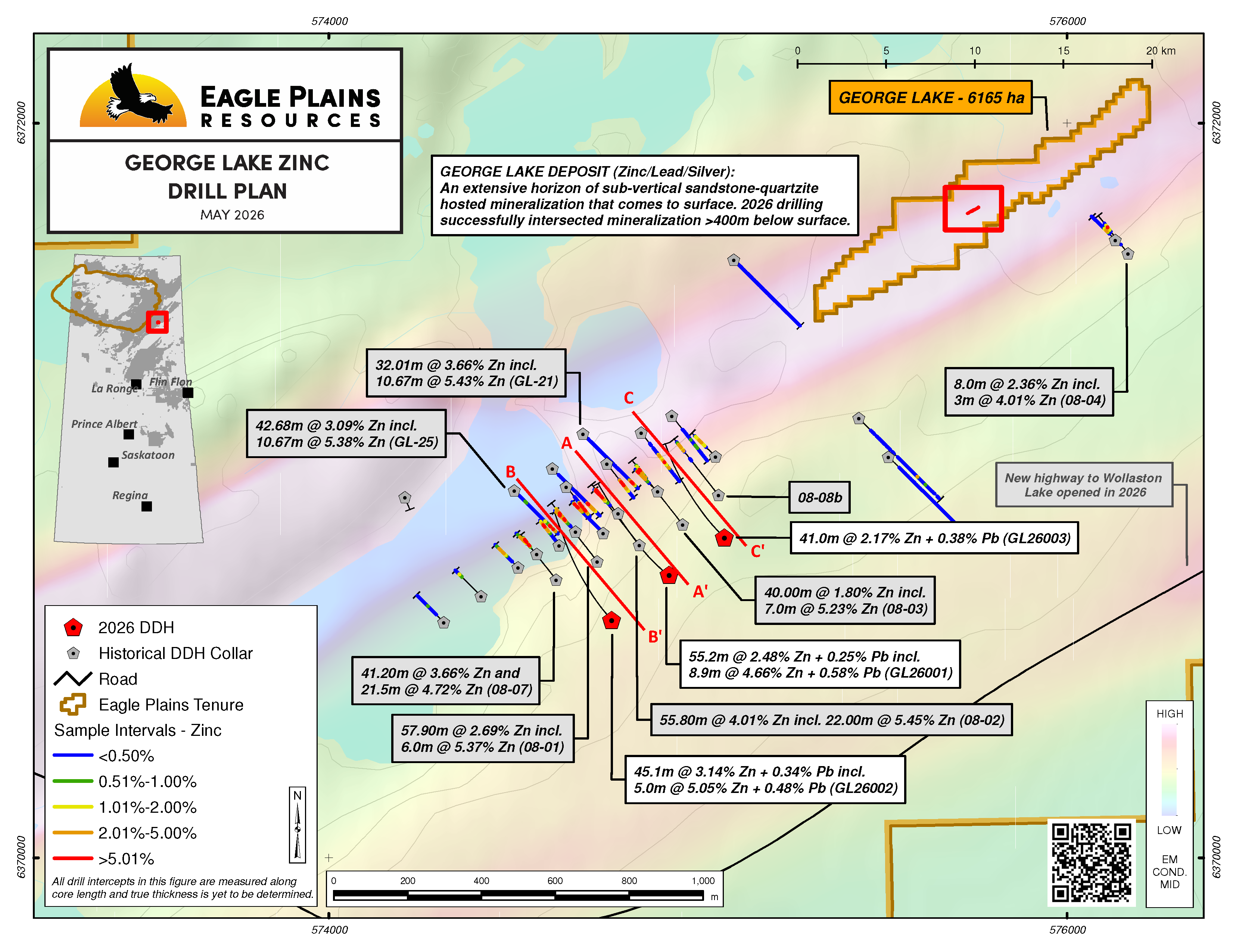
- 2026 step-out drilling confirmed continuity of mineralization to >400m vertical depth, extending the defined deposit to 610m along strike and 420m vertically, and remaining open to depth and along strike;
- A 2024 geophysical interpretation and conceptual Exploration Target* of 2 to 5 million tonnes grading 3-5% Zn and 0.5-1.5% Pb have identified significant potential to expand the deposit along a broader ~8.1 km prospective corridor;
- Cost-effective, year-round exploration supported by excellent infrastructure and a formal Exploration Agreement with the Ya’thi Néné Lands and Resource Office (YNLR).
*This Exploration Target is based on 2024 geophysical modelling (interpretation of the 2022 VTEM airborne survey and a magnetic inversion) together with the historical drilling record at George Lake. The potential quantity and grade is conceptual in nature; there has been insufficient exploration to define a mineral resource, and it is uncertain if further exploration will result in the target being delineated as a mineral resource.
Summary
The 6165 ha George Lake Property is host to the historical, sediment-hosted, George Lake Deposit. The mineralized horizon is stratigraphically controlled, sub-vertical, and mineralization is zinc and lead dominant. Step-out drilling by Eagle Plains in 2026 has defined mineralization to a vertical depth of >400m from surface. Mineralization remains open along strike and to depth.
The property is located 280 km northeast of La Ronge, Saskatchewan and is accessible by a newly constructed, all-season road. The George Lake Property dispositions are 100% owned by Eagle Plains with a 2% NSR held by Summit Royalties containing a 1% buy-back clause in favor or Eagle Plains for $1,000,000. This area qualifies for the Targeted Mineral Exploration Incentive (TMEI) program offered by the Government of Saskatchewan.
Project Highlights
- Host to the historically defined George Lake Deposit (SMDI 0663);
- Deposit is a predictably mineralized sandstone horizon dominated by zinc and lead with accessory silver, gallium and germanium;
- Historical drilling includes 57.9m grading 2.65% Zn and 0.41% Pb (including 13.5m grading 4.36% Zn and 0.76% Pb) (DDH GL08-01) and 47.8m grading 4.03% Zn and 0.44% Pb (including 8.0m grading 6.96% Zn and 1.42% Pb) (DDH GL08-02) (SMAF 64E05-0033);
- 2026 step-out drilling confirmed continuity of mineralization to >400m vertical depth, extending the defined deposit to 610m along strike and 420m vertically, and remaining open to depth and along strike;
- A 2024 geophysical interpretation and conceptual Exploration Target* of 2 to 5 million tonnes grading 3-5% Zn and 0.5-1.5% Pb have identified significant potential to expand the deposit along a broader ~8.1 km prospective corridor;
- Cost-effective, year-round exploration supported by excellent infrastructure and a formal Exploration Agreement with the Ya’thi Néné Lands and Resource Office (YNLR).
*This Exploration Target is based on 2024 geophysical modelling (interpretation of the 2022 VTEM airborne survey and a magnetic inversion) together with the historical drilling record at George Lake. The potential quantity and grade is conceptual in nature; there has been insufficient exploration to define a mineral resource, and it is uncertain if further exploration will result in the target being delineated as a mineral resource.
Geology
The George Lake property is found in the Wollaston domain which is host to several significant base metal occurrences. In the George Lake area, SEDEX-type Pb-Zn-Ag mineralization is found in quartzite and meta-argillite of the Souter Lake group and Spence Lake formation, respectively. Mineralization in the Souter Lake group occurs as stratabound, disseminated sulfides comprising pyrite, pyrrhotite, sphalerite, and galena. Mineralization in the Spence Lake Formation occurs as stratiform disseminated pyrrhotite, pyrite, sphalerite, and galena, and as vein-hosted arsenopyrite, pyrite, pyrrhotite, and subordinate sphalerite and galena. Mineralization in both units is associated with syn-depositional faulting.
Eagle Plains Exploration
Eagle Plains acquired George Lake in June 2023 (See June 13, 2023 News Release) and has since compiled historical data, flown and interpreted a high-resolution geophysical survey, and completed its first drill program at the project in nearly two decades. The 2026 program (1,591m in three step-out holes) confirmed continuity of mineralization to >400m vertical depth, including 45.1m grading 3.14% Zn and 0.34% Pb (DDH GL26002) (See May 7, 2026 News Release). Eagle Plains has also outlined a conceptual Exploration Target* of 2 to 5 million tonnes grading 3-5% Zn and 0.5-1.5% Pb along a broader ~8.1 km prospective corridor beyond the currently defined deposit (See February 2, 2026 News Release).
Future Work
Future work will focus on continued expansion of the known George Lake mineralization, both down-dip and along strike - only 610m of the roughly 8.1 km prospective corridor has been adequately tested by diamond drilling to date. Priority targets include three geophysical anomalies (TZ3, TZ10, and TZ15) identified through 2024 geophysical interpretation, alongside continued work toward delineating the conceptual 2–5 million tonne Exploration Target* (See February 2, 2026 and May 7, 2026 News Releases).
*This Exploration Target is conceptual in nature: there has been insufficient exploration to define a mineral resource, and it is uncertain if further exploration will result in the target being delineated as a mineral resource. The target is based on 2024 geophysical modelling and the historical drilling record at George Lake (See February 2, 2026 News Release).
Details
Geology
The George Lake property is found in the Wollaston domain, and comprises greenschist-amphibolite facies metasedimentary and minor metavolcanic rocks of the middle Paleoproterozoic Wollaston Supergroup. The Wollaston domain is bounded to the southeast by late Archean gneisses of the Peter Lake domain, which are locally unconformably overlain by the Wollaston Supergroup. To the northwest, the Wollaston domain is transitional to the Mudjatik domain comprising Archean gneiss. Both the Wollaston and Mudjatik domains are unconformably overlain by the Athabasca basin, a late Paleoproterozoic clastic sedimentary basin.
Metasedimentary rocks in the southeast Wollaston domain host several significant base metal occurrences. In the George Lake area, SEDEX-type Pb-Zn-Ag mineralization is found in quartzite and meta-argillite of the Souter Lake group and Spence Lake formation, respectively. Mineralization in the Souter Lake group occurs as stratabound, disseminated sulfides comprising pyrite, pyrrhotite, sphalerite, and galena in a white and grey quartzite. Mineralization in the Spence Lake formation occurs as stratiform disseminated pyrrhotite, pyrite, sphalerite, and galena, and as vein-hosted arsenopyrite, pyrite, pyrrhotite, and subordinate sphalerite and galena.
The George Lake property is on the southeastern edge of the Wollaston domain in the Compulsion River fold belt. Rocks underlying the George Lake property comprise greenschist to amphibolite metasedimentary sequences of Wollaston Supergroup. Metamorphic grade generally increases to the northwest, where rocks of the Marginal Pelite unit are amphibolite facies and primary fabrics are obscured. Primary structures are preserved in the lower grade rocks occupying most of the property area. Bedding is very steeply dipping to vertical and locally overturned on the northwest limb of the Spence Lake Synform. Rapid thickening and facies changes in sedimentary units suggests syndepositional faulting on north-south trending faults.
The dominant structural grain of the property is a steeply northwest dipping foliation, axial planar to the Spence Lake Synform. This fabric has been weakly overprinted by conjugate northeast and southwest plunging folds. A late north-south trending sinistral fault zone cuts all units and displaces lithologic contacts in the southwestern portion of the property area.
Mineral occurrences on the George Lake Property include stratabound, disseminated sphalerite and galena, and vein-hosted arsenopyrite, sphalerite, and galena, interpreted as SEDEX-type mineralization. Stratabound Pb-Zn-Ag-mineralization is predominantly found disseminated in quartzite of the upper Souter Lake group near the contact with the overlying meta-argillite. The Spence Lake Formation also hosts stratabound Pb-Zn-Ag mineralization, but at lower grades. Vein-hosted arsenopyrite, galena, and sphalerite are predominantly found as blebs in quartz-veins hosted in meta-argillite of the Spence Lake formation, as well as disseminated grains in the host rock. Non-visible silver is associated with both mineralization styles in the George Lake property.
Eagle Plains Exploration
In June 2023, Eagle Plains completed the acquisition, by staking and claim purchase from unrelated third parties, of the then-3,694 ha George Lake critical metals project (See June 13, 2023 News Release). Following acquisition, Eagle Plains completed a detailed compilation of all available historical data on the property and carried out preliminary fieldwork.
In December 2023, Eagle Plains reported that a 2022 Government of Saskatchewan airborne electromagnetic and magnetic survey - flown by Geotech Canada Inc. using a VTEM Max time-domain EM system on 200m line spacing - had covered the entirety of the George Lake property. The survey identified a strong southwest-northeast trending EM conductor coincident with the George Lake deposit mineralization and only partially drill-tested, along with weaker parallel conductor trends to the north and south, the northern of which is coincident with the Spence Lake mineralized zone (See December 5, 2023 News Release).
In 2024, Eagle Plains contracted EarthEx Geophysical Solutions to complete a detailed interpretation of the 2022 VTEM survey data. The work identified 17 target zones, three of which - TZ3, TZ10, and TZ15 - have been prioritized for follow-up investigation. A magnetic inversion component of the study indicated that the contact hosting the George Lake deposit is near-vertical and continuous to depth, providing further constraints for drill targeting (See February 2, 2026 News Release).
Based on the 2024 geophysical modelling together with historical drilling - including the continuous nature, reported grades, and shallow depth of historical intersections - Eagle Plains has outlined a conceptual Exploration Target of 2 to 5 million tonnes grading 3-5% Zn and 0.5-1.5% Pb (See February 2, 2026 News Release). The potential quantity and grade of this target is conceptual in nature; there has been insufficient exploration to define a mineral resource, and it is uncertain if further exploration will result in the target being delineated as a mineral resource.
In July 2025, Eagle Plains and the Ya’thi Néné Lands and Resource Office (YNLR) - representing the Athabasca Denesułiné First Nations of Hatchet Lake, Black Lake, and Fond du Lac, the Northern Hamlet of Stony Rapids, and the Northern Settlements of Uranium City, Wollaston Lake and Camsell Portage - added George Lake to the existing Exploration Agreement between the two parties. The Agreement supports mineral exploration in Nuhenéné, the traditional territory of the Athabasca First Nations in Treaty 8 and Treaty 10 territories, and provides for local employment and training, contracting with northern businesses, contributions to a YNLR community trust, harvester compensation, and on-site oversight of exploration activities by YNLR Community Land Technicians (See July 10, 2025 News Release).
In January 2026, Eagle Plains announced a fully funded, 1,650m, three-hole diamond drill program at George Lake - its first drilling at the project since 2008 - designed to test the sedex-hosted stratigraphy in systematic 200m step-outs, both down-dip and along strike, from historical intersections such as 8.0m grading 6.96% Zn, 1.42% Pb and 5.91 g/t Ag within a broader 47.8m interval (DDH GL08-02). The program was conducted by TerraLogic Exploration Inc. of Cranbrook, BC, under the direction of Kerry Bates, P.Geo., Eagle Plains’ Exploration Manager, with drilling completed by New Age Drilling Solutions (See January 12, 2026 News Release).
Drilling commenced in early February 2026 (See February 2, 2026 News Release). By early March, all three holes - GL26001, GL26002, and GL26003 - had successfully intersected the George Lake Zn/Pb deposit horizon, with the deepest intersection to date approximately 208m vertically below the deepest historical intercept (See March 4, 2026 and March 10, 2026 News Releases).
Assay results, received and reported in May 2026, confirmed the continuity of mineralization in all three holes to a vertical depth of >400m from surface, extending the defined deposit over 610m of strike length and 420m of vertical depth, with mineralization remaining open along strike and to depth. A total of 1,591m was drilled across the three holes (See May 7, 2026 News Release).
|
Hole ID |
From (m) |
To (m) |
Interval (m) |
Ag (g/t) |
Pb (%) |
Zn (%) |
Zn+Pb (%) |
|
GL26001 |
480.9 |
536.1 |
55.2 |
1.70 |
0.25 |
2.48 |
2.73 |
|
incl. |
502.1 |
511.0 |
8.9 |
2.13 |
0.58 |
4.66 |
5.23 |
|
GL26002 |
472.0 |
517.1 |
45.1 |
1.44 |
0.34 |
3.14 |
3.48 |
|
incl. |
480.0 |
498.0 |
18.0 |
2.20 |
0.61 |
4.45 |
5.05 |
|
GL26003 |
402.0 |
443.0 |
41.0 |
1.67 |
0.38 |
2.17 |
2.55 |
|
incl. |
411.6 |
414.4 |
2.8 |
2.76 |
0.61 |
4.25 |
4.85 |
Stratiform mineralization at the deposit occurs as disseminated sphalerite-pyrite and minor galena, with local sphalerite stringer veins, hosted in clean, silicified white quartzite of the upper Souter Lake Formation, bound by overlying argillite (George Lake Formation) and underlying biotitic quartzite (Souter Lake Formation) that together form a stratigraphically controlled porosity trap for migrating mineralizing fluids. Deposit-type interpretation is ongoing; mineralization is consistent with the sandstone-hosted Zn/Pb mineralization of the Laisvall Deposit and may represent epigenetic mineralization within a broader SEDEX or MVT-type system (See May 7, 2026 News Release).
The project was eligible for the Saskatchewan Targeted Mineral Exploration Incentive (TMEI), which provided funding of up to $150,000 toward drilling-related program costs (See January 12, 2026 and May 7, 2026 News Releases).
All drill-indicated intercepts reported above are measured along core length; true thickness of the mineralized zone has not yet been determined.
Chuck Downie, P.Geo., President and CEO of Eagle Plains, stated: “The results from the 2026 drilling demonstrate the predictable orientation of the George Lake mineralization and the potential for further expansion. With only 610m of the almost 8km strike length of known mineralization adequately tested by diamond drilling, we believe that continued wide spaced drilling can rapidly expand the footprint of the mineralized zone. The excellent infrastructure and property topography lends itself to cost effective year-round exploration.” (See May 7, 2026 News Release)
History
Reconnaissance exploration in the George Lake area began in 1965 with a geophysical aeromagnetic survey followed up with mapping and prospecting. Sphalerite- and galena-bearing quartzite boulder trains were discovered at the southwest end of George Lake extending 15 km southwest and 40 km northeast of George Lake. Two sphalerite bearing outcrops were discovered at the south end of George Lake and 18 trenches excavated but thick overburden prevented significant exposure of bedrock. 2 diamond drill holes (112m) did not intersect any mineralization.
In the summer of 1965 Falconbridge Nickel Mines Ltd. staked George Lake and surrounding area and in 1966 completed mapping, ground geophysics, soil geochemistry. Four diamond drill holes (894m) were completed to test magnetic geophysical anomalies and interpreted the source to be minor pyrrhotite- and pyrite-bearing meta-argillite and quartzite and garnet biotite schist. Mineralization was discovered in the fall of 1966. In 1967, further geologic mapping, soil surveys, and ground magnetic surveys completed coverage of the area and helped trace stratigraphic contacts covered by overburden.
From 1969-1970, Compulsion River Mines Ltd. drilled 34 holes (5127m) to delineate the George Lake deposit over a strike length of approximately 15 km. Most drill holes intersected mineralization at 45–60m vertical depth, while 3 deeper holes extended mineralization to below 150m. A resource was approximated to be 5 million tonnes grading 2.65% Zn and 0.38% Pb (1% Zn cutoff), including a high-grade zone containing 2.9 million tonnes grading 3.67% Zn and 0.53% Pb (2% Zn cutoff) (SMDI 0663).
In 1977 the government of Saskatchewan produced a geologic map of the area.
In 1980 and 1981, Pressuag Canada and Saskatchewan Mining and Development Corporation (SMDC) explored the George Lake area for stratabound base-metal mineralization. Work included lake sediment, soil, and glacial till geochemical surveys, geological mapping, and magnetic/EM geophysical surveys. In 1983/4 the SMDC conducted geologic mapping, soil geochemical surveys, and magnetic/VLF-EM geophysical surveys noting the potential for base metal mineralization in the area.
In 1986, Esso Minerals Canada conducted preliminary lithogeochemical sampling, airborne magnetic and EM geophysical surveys in the George Lake area. Ground geochemical and geophysics surveys were conducted over target areas in 1987 and 1988 followed by 5 diamond drill holes (527m) which intersected iron formation and Zn-enriched strata. Later that year an Esso/Bow Valley Industries JV conducted soil geochemical surveys and reinterpreted the airborne geophysics. 12 diamond drill holes (1471m) were completed intersecting subeconomic base-metal mineralization at several targets.
In 1990, Falconbridge flew EM, VLF-EM, and magnetic geophysical surveys that covered the George Lake deposit. Drill core from 1965-1970 was also relogged and resampled for multielement geochemical analysis.
In 1992, Noranda Exploration and Mining Company conducted a genie-EM geophysical survey along a slate horizon which traced a stratigraphic boundary beneath thick overburden. Two diamond drill holes (301m) tested the lower stratigraphy of the Souter Lake formation and did not intersect any significant mineralization.
From 1995-1998, Far West Mining completed bulk till and soil geochemical sampling across a very large area including the George Lake property. A Zn-anomaly was identified on the north shore of George Lake.
In 2002, Odaat identified a zone of elevated magnetics over the deposit location. Southwestward shifts in the magnetic anomalies were interpreted as potential faults and additional magnetic geophysical surveys were recommended.
In 2008, Golden Arch Resources drilled 6 holes (1706m) along the main George Lake deposit showing. Drill core data correlated very well with previous drill results and identified a notable Ag-resource that was previously undescribed.
Qualified Person
Charles C. (Chuck) Downie, P.Geo., a director of Eagle Plains, is the qualified person for the purposes of National Instrument 43-101 who has reviewed and approved the scientific and technical information presented on this page. Mr. Downie is not independent of Eagle Plains within the meaning of NI 43-101.
Eagle Plains - A Project Generator
Eagle Plains Resources is a project generator with several mineral exploration properties of merit that meet qualifying transaction requirements. We facilitate the listing process for capital pool companies and initial public offerings while providing technical expertise for exploration programs. Companies interested in co-operatively exploring any of our projects please contact: Chuck Downie at ccd@eagleplains.com or Andrew Wilson at abw@eagleplains.com or call 1 866 Hunt Ore (486 8673).
Updated Aug 24, 2026

Eagle Plains Expands George Lake Deposit Mineralization, Reports 3.48% Zn+Pb over 45.1m in Step-out Drilling

Eagle Plains Completes Drilling at George Lake Critical Metals Project, Intersects Target Mineralization in All Holes

Eagle Plains Intersects Mineralization in Step-out Holes at George Lake Critical Metals Project, Saskatchewan

Drilling Commences at Eagle Plains 100% Owned George Lake Critical Metals Project, Saskatchewan
Photos


