
Bulldog Project
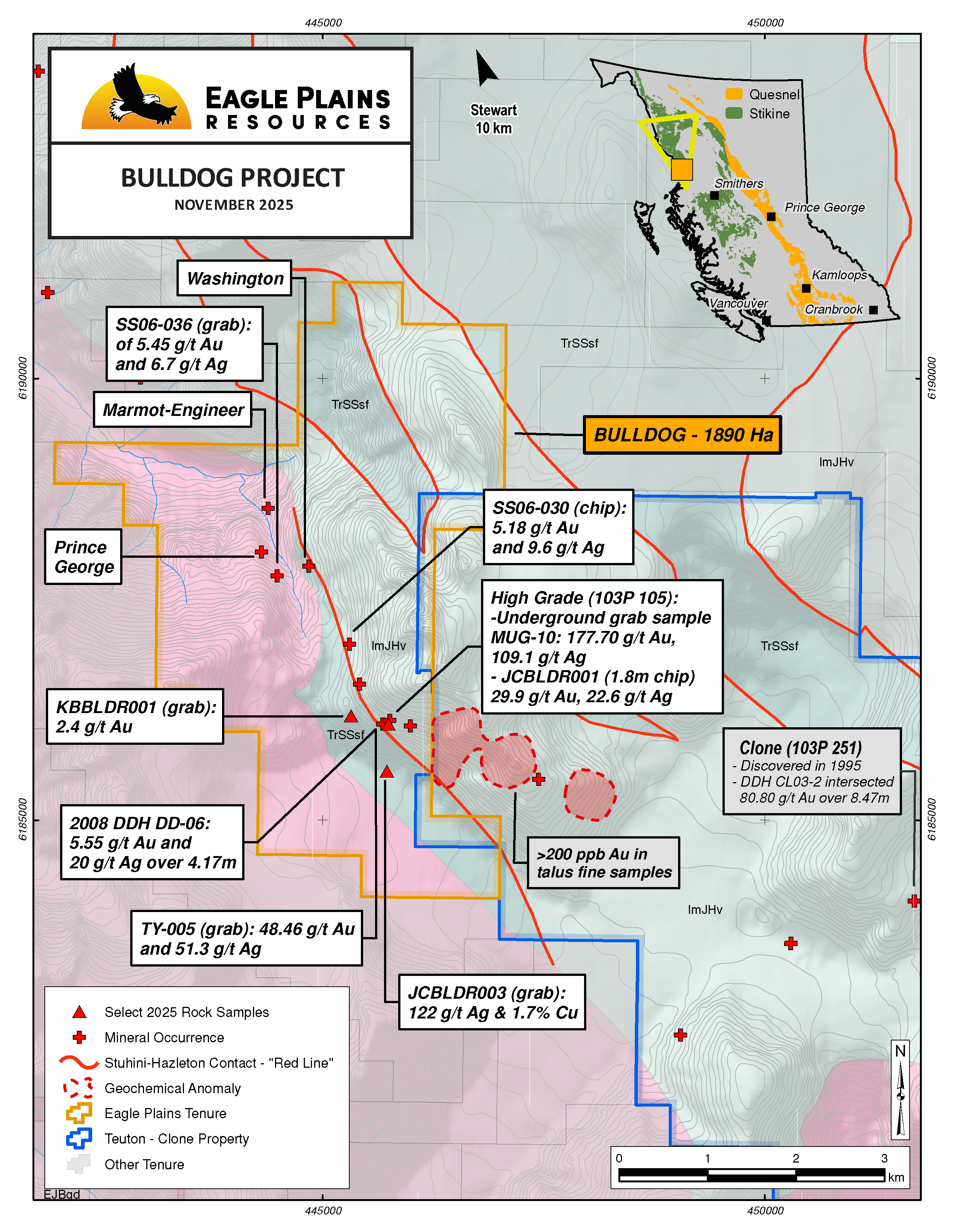
The 1,890 ha Bulldog Project is located in northwestern British Columbia, approximately 11 km southwest of Stewart, within the southern extent of BC’s ‘Golden Triangle’, a geological region known to host globally significant precious- and base-metal deposits. The property hosts numerous surface showings and historical underground workings, highlighting the potential for high grade Au-Ag mineralization in shear zones and veins. The claims were acquired in 2025 through a combination of staking and third-party purchase agreements and are owned 100% by Eagle Plains with no underlying royalties or encumbrances.
The property is accessible by helicopter from the nearby community of Stewart, B.C. and is contiguous with Teuton Resources’ Clone Project, Dolly Varden Silver’s Porter-Idaho Project, and Goliath Resources’ Golddigger Project.
-
- British Columbia
-
- Available for option: Yes
-
- Gold,
- Silver
Project Highlights
- Located in the Stikinia Terrane within the Golden Triangle
- Vein and shear hosted high-grade Au and Ag mineralization at surface
- Historical underground and surface results highlight potential for widespread Au-Ag mineralization
-
Numerous mineralized occurrences
- Excellent potential to expand known mineralization along strike and down-dip
Details
The 1,890 ha Bulldog Project is located in northwestern British Columbia, approximately 11 km southwest of Stewart, within the southern extent of BC’s ‘Golden Triangle’, a geological region known to host globally significant precious- and base-metal deposits. The property hosts numerous surface showings and historical underground workings, highlighting the potential for high grade Au-Ag mineralization in shear zones and veins. The property is accessible via helicopter out of nearby Stewart and is within terrain typical of the Coast Mountains.
The claims were acquired in 2025 through a combination of staking and third-party purchase agreements and are owned 100% by Eagle Plains with no underlying royalties or encumbrances. The property is contiguous with Teuton Resources’ Clone Project, Dolly Varden Silver’s Porter-Idaho Project, and Goliath Resources’ Golddigger Project.
Project Highlights
- Located in the Stikinia Terrane within the Golden Triangle
- Vein and shear hosted high-grade Au and Ag mineralization at surface
- Historical underground and surface results highlight potential for widespread Au-Ag mineralization
- Numerous mineralized occurrences
- Excellent potential to expand known mineralization along strike and down-dip
Geology
The project overlies volcanic and sedimentary stratigraphy of the Stikinia Terrane (Hazelton Group), an island arc assemblage, later intruded by the Bulldog (Jurassic) and Hyder (Eocene) plutonic rocks. At property scale, volcanic and sedimentary stratigraphy dominate the eastern portion of the property and can be divided into the Betty Creek (Unuk River Member) and Salmon River Formations. The Betty Creek Formation represent the oldest rocks on the property, consisting of andesitic flows, breccias and volcaniclastic rocks. Bedding is locally well preserved in rhyolitic tuffs. Overlying the Betty Creek Formation is a sequence of intercalated argillite, siltstone and sandstones of the Salmon River Formation. Both the Betty Creek and Salmon River Formations display variable hornfels alteration proximal to the contact with the Bulldog Creek and Hyder plutonic rocks. A series of NW striking, NE dipping shear veins are interpreted to be the dominant control on Au mineralization on the property. Reports from underground development in the south end of the property indicate a second E-W striking, N dipping structural fabric also hosts similar shear vein mineralization.
The western portion of the property overlies predominantly medium grained, equigranular quartz monzodiorite and quartz monzonite of the Bulldog Creek pluton. Epidote and chlorite alteration of the plutonic rocks is widespread and typically associated with extensive anastomosing epidote-chlorite-quartz veinlets. While plutonic rocks on the property have not been the focus of historical exploration, results from the Prince George occurrence highlights the potential for gold and silver-bearing mineralization hosted in quartz veins up to 1.2m wide.
Mineralization
Four BC MinFile occurrences are documented within the current Bulldog tenure: High Grade (103P 105), Washington (103P 104), Marmot Engineer (103P 103) and Prince George (103P 107). Mineralization at the High Grade, Washington and Marmot Engineer is reported in shear hosted quartz-carbonate veins within volcanic and sedimentary stratigraphy of the Hazelton Group. Mineralization at the Prince George occurrence demonstrates the mineralization potential of quartz veins within the Bulldog Pluton.
At the High Grade occurrence, mineralization is reported in three subparallel quartz-carbonate veins within sheared volcanic stratigraphy of the Betty Creek Formation (Hazelton Group). The lowermost vein (270°/45°) is reported up to 1.0m wide with pyrite-chalcopyrite mineralization forming lenses along the vein margins. Historical results (1926) report quartz vein samples up to 86.2 g/t Au and 123.0 g/t Ag over an unreported width. The middle vein, orientated 125°/45°, is up to 2.1m wide. Sulphides (pyrite-chalcopyrite-sphalerite-galena) typically form lenses and pods along vein margins with lesser mineralization forming disseminations and fracture fill of the wallrock. At surface, a 1.8m chip sample returned 29.9 g/t Au and 22.6 g/t Ag (2025). A historical adit developed in the 1920’s further exposes the vein at the back of an 80m drift where modern sampling of the down-dip extension of the vein reports 20.7 g/t Au and 68.3 g/t Au. The upper vein is reported to be subparallel to the middle vein (125°/50°), with historical grab sampling reporting up to 7.6 g/t Au.
The Washington occurrence is defined by sulphide mineralization in sheared volcanic breccias and lithic tuff of the Betty Creek Formation (Hazelton Group). Mapping completed between 2013-2015 identified 4 subparallel near vertical, NW trending shear zones, up to 1.8m wide, at 15-30m spacing. Shear zones are gossanous, hosting pyrite-galena-sphalerite-malachite±tetrahedrite mineralization. Historical development (1920’s) at the Washington occurrence includes a 120m adit driven 30m down-slope of the mapped shears. Modern assessment of the workings indicate it failed to intersected any significant structure or mineralization, likely the result of structural offset. A 2006 surface rock (grab) sample from a gossanous shear returned 0.6 g/t Au and 87.9 g/t Ag.
The Marmot Engineer occurrence consists of two quartz vein breccias hosted in altered argillites of the Salmon River Formation (Hazelton Group) proximal to the contact with the Bulldog Pluton. Two parallel vein breccias (150°/70°), 1.8-2.4m wide, have been mapped on surface. Sulphide mineralization (pyrite-sphalerite-galena-chalcopyrite) was the target of historical underground development (1930), but grades are unknown. Follow-up prospecting and mapping completed in 2006 report surface samples of mineralized vein material up to 0.4 g/t Au and 123.8 g/t Ag.
The Prince George Occurrence is defined by a 1.2m wide quartz vein hosted in Bulldog Pluton granodiorite. Sulphide (pyrite-chalcopyrite-galena-sphalerite) mineralization forms lenses and minor disseminations within the vein. In 1921 surface trenching was completed to further expose the vein, with grades reported up to 66.3 g/t Au and 411.0 g/t Ag (unknown width). Follow-up prospecting completed between 2006-2015 reported up to 4.2 g/t Au and 99.3 g/t Ag (2006).
Exploration History
After initial discovery of gold and silver-bearing quartz veins and structures in 1917, significant exploration occurred at the High Grade, Washington, Prince George and Marmot Engineer occurrences between 1921-1930. Historical work focused on defining surface mineralization through trenching and development of adits to assess down-dip continuity of sulphide mineralization within shear structures.
In 1987 Corning Resources conducted geological mapping, rock and soil geochemistry at the High Grade occurrence. Analytical results from 16 rock samples reported Au grades of up to >1 g/t associated with As, Cu, Pb and Sb. In 1993-1995 Navarre Resources Corp. conducted geological mapping, rock/soil/silt geochemistry and a ground geophysical survey (VLF-EM and magnetometer) at the High Grade occurrence. The work defined NW trending structures interpreted to be the dominant control of vein and shear hosted mineralization within volcanic and sedimentary stratigraphy. Sampling at the High Grade occurrence reported up to 1.3m @ 100.0 g/t Au and 177.6 g/t Ag
In 1997 a series of 13 small diameter holes were drilled into the High Grade occurrence by Navarre Resources Corp. Results from the program were not made public.
In 2006 Enterayon Inc completed extensive underground and surface sampling at the High Grade workings in conjunction with a seven hole, 254m diamond drill program. Surface sampling returned significant results including a rock sample east of the High Grade zone reporting 1.59 g/t Au and 176.1 g/t Ag. A sample of oxidized quartz vein material 700m northwest of the High Grade workings returned 5.18 g/t Au and a quartz vein float material from the Prince George showing returned 5.45 g/t Au. Underground sampling at the High Grade workings returned grab samples up to 177.7 g/t Au and 243.5 g/t Ag. Diamond drilling at the High Grade occurrence tested approximately 35m of the strike length. The best results were from DDH DD-06, which returned 4.2m @ 5.6 g/t Au and 20.0 g/t Au from 19.4 – 23.6m, true with unknown.
In 2009 Castle Resources Inc. conducted check sampling of the underground workings at the High Grade Occurrence. Results confirmed the historical grades of Au and Ag mineralization with a sample collected from the middle adit returning 20.7 g/t Au and 68.3 g/t Ag.
In 2011 Castle Resources completed three diamond drill holes at the High Grade Occurrence, designed to intersect the vein deeper (down-dip) of the 2006 drilling. Results from the program indicate the structure and mineralized vein was successfully intersected, with DDH HS11-06 returning 1.0m @ 13.0 g/t Au from 119.0m – 120.0m.
In 2015-2017 Granby Gold Inc conducted geological mapping and interpretation of regional airborne geophysics at the High Grade and Washington occurrences. The programs further defined host-rock stratigraphy and repositioned the contact between Hazelton stratigraphy and the Bulldog Pluton.
In 2018 Granby Gold Inc. conducted a 30.6 km2 high resolution, helicopter-borne magnetic and radiometric survey. The program was designed to assess geophysical anomalies that could be consistent with VMS-type mineralization and to better define geophysical characteristics of known, structurally controlled vein hosted mineralization.
Eagle Plains Exploration
In 2025 Eagle Plains Resources completed a 2-day initial field assessment of the project. Rock sampling at the High Grade workings confirmed reported surface grades of the mineralization. A 1.8m rock chip sample across the vein above the middle adit returned 29.9 g/t Au, 22.6 g/t Ag and 0.2% Cu. A second sample, collected 50m NW along the same vein trend, returned 17.7 g/t Au and 26 g/t Ag.
Prospecting efforts 500m south of the High Grade vein focused on an area where the Bulldog Glacier has retreated exposing new outcrop with no known historical work. A rock (grab) sample collected from a brittle W trending shear zone in argillite returned 122 g/t Ag, 1.7% Cu and 0.7% Zn.
A rock (grab) sample collected 162m SW of the High Grade lower adit returned 2.4 g/t Au from a bedded argillite unit with chaotic swarms of quartz vein up to 7 cm wide. No known historical work has been documented at the showing, which represents a new mineralized horizon in the footwall stratigraphy of the High Grade zone.
Future Work
- Tier II data compilation including digitizing all publicly available exploration data and creating a digital database
- Continued surficial geochemical surveys to expand on historical anomalies and generate new exploration targets
- Detailed geological mapping to better understand lithological and structural controls of mineralization
- Prospect and evaluate the northern half of the property
- Generate a 3D geological model
Eagle Plains - A Project Generator
Eagle Plains Resources is a project generator with several mineral exploration properties of merit that meet qualifying transaction requirements. We facilitate the listing process for capital pool companies and initial public offerings while providing technical expertise for exploration programs. Companies interested in co-operatively exploring any of our projects please contact: Chuck Downie at ccd@eagleplains.com or Andrew Wilson at abw@eagleplains.com or call 1 866 Hunt Ore (486 8673).
Updated March 19, 2026

Eagle Plains Reports up to 29.9 g/t Au over 1.8m at the Bulldog Gold – Silver Project, Golden Triangle, BC
Photos


